
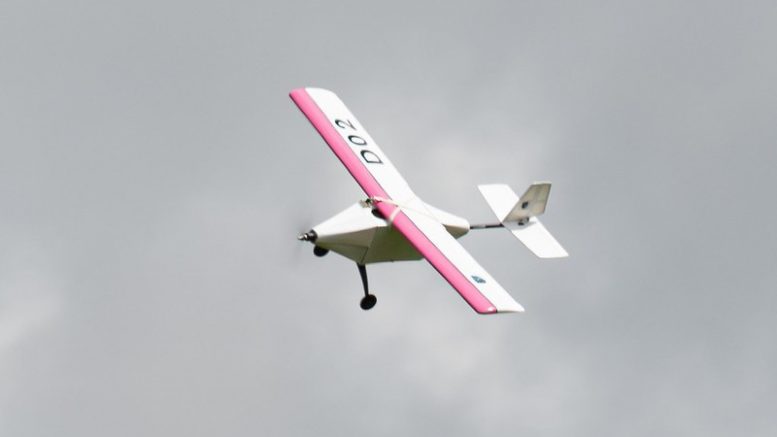
The annual, BMFA University and Schools Payload Challenge took place at the BMFA National Centre on the 10th and 11th of June, with the 9th available to teams for set up and practice flights.
This year’s competition received entries from a small number of Europe based teams, as well as a strong attendance from UK universities, schools and home education groups.
We had 36 teams entered for 2026 which was very positive.
The Challenges – A reminder
The competition has evolved over time with varying payloads and aircraft configurations, currently all classes are electric powered, and utilise a specified 4Max motor and speed controller combination, in conjunction with a specified battery which we provide to ensure standardisation and fairness.
To recap, the current categories are: –
Challenge 2 – Cube lift – teams design and build aircraft to transport standard Rubik’s Cubes around the course. Perhaps regarded as the entry level challenge, however, it still requires teams to think carefully about their design and materials use to obtain the best performance from the airframe and battery.
Challenge 3 – Distance – teams must design and build an aircraft to carry the specified payload of a large block of balsa around the course for the greatest number of laps in the prescribed time allocation.
Challenge 4 – aircraft are designed to transport the largest number of 150mm diameter polystyrene spheres around the course in the allocated time, the ultimate test of design and teamwork. This class traditionally generates some of the most innovate shapes due to the awkward nature of the payload.
Challenge 5 – aircraft are required to carry up to 4kg of water as a payload, with scoring based on the largest aggregate of airframe to payload weight, requires innovation in design and understanding of materials and aerodynamics. The aggregate weight aspect of the scoring produces some superbly constructed and lightweight airframes.
The competition is launched early in the academic year with teams required to submit drawings 30 days prior to the flying element of the competition.
Competition Day 1
The Tuesday is allocated as an arrival and set up day with the option to fly for those teams still requiring test flights, this year a number of teams had taken up this opportunity and arrived in good time to claim their spot in the Goldsmith Hangar and to conduct final set up flights (and a couple of initial test flights).
Wednesday was the first competition day and as always started with a morning briefing to cover the usual safety and housekeeping aspects, as well as competition procedures.
The Hangar was very full of teams and aeroplanes, and it was clear from the beginning that the general standard of aircraft was again very good. As always there was quite a selection of aircraft evident, with everything from fairly “aeroplane shaped” composite structures to some rather more…. imaginative designs.
With the rather difficult forecast of showers throughout Wednesday and steady rain for most of Thursday the emphasis was very much on getting teams through processing and model scrutineering, in order to give the best chance of putting in scoring flights possible.
Competition procedures require teams to pre-submit a set of drawings and reports for their aircraft (the requirements for the lower Challenges are less academically rigorous) which details the aircraft construction and systems. These reports are assessed and marked by our panel of professional engineering judges and form an important aspect of the team’s overall score.
Additionally, teams are required to carry out a 5 minute presentation to the judging panel (led by Chief Judge, Peter Rieden) which describes the design and build process of their aircraft as well as any technical highlights.
Presentations are usually shared by team members with individuals covering their particular area of design and involvement. The presentations always make for interesting spectating and again represent an important opportunity for teams to gain valuable points towards their overall score.
Previously teams have had to complete both scrutineering and presentation before being eligible to fly, however, for this year teams were able to fly as soon as their aircraft had been scrutineered with presentation fitted in at any time during the day, this made things flow much better and kept us ahead of the weather.
Final scores are the total of all three aspects of the competition, reports/drawings, presentation to judges, and finally the flight scores.
Flight Competitions
As in previous years the flightline was run by Matt Hoyland (of F3A RC Aerobatics fame) assisted by a team of helpers.
The flight requirements for each competition class vary, but most require flight around the prescribed course with flag Marshalls placed at either end to indicate to pilots when the turnaround point is reached.
For the Cube and Distance categories there is a very definite speed element as the score is calculated based on the number of complete laps flown within the specified time period, however there is also a strong teamwork element as the payload needs to be loaded before flight and during the rounds.
For Challenge 4, Quantity, the emphasis becomes focussed on good design and efficiency of team operations.
Aircraft are designed to carry a payload of 150mm polystyrene spheres, not heavy, but an awkward payload and the flight score is based on the total number of spheres transported around the course in the prescribed flight time. So teams have an interesting decision to make early in the design process, a sleek, fast airframe that can carry a small number of spheres and get round the course multiple times, or something that can perhaps carry a larger number of spheres but as a result is likely to achieve significantly less laps.
This year most teams had opted for a “middle ground” solution in terms of number of spheres carried.
Where large number of speres are carried it places an additional emphasis on the team aspect, as loading and unloading payload becomes a co-ordinated activity, all a great test of innovation and organisation and great fun to watch.
Challenge 5 has always been regarded as the “premier class” and always attracts the highest number of entries each year.
The flight score for Challenge 5 is based on three flights, a qualifying empty flight (no payload), a flight with 2 kilograms of payload and a final flight with 4 Kilograms of payload (the payload for Challenge 5 is water).
Scoring is based on the aggregate weight between payload and airframe which can lead to fairly fragile airframes and in particular, undercarriages always seem to present teams with a challenge, 4 Kg of payload is a great airframe integrity test.
The weather
For this year’s competition the weather played a very significant role as the forecast for the two days was pretty dire, this placed a significant emphasis on teams being ready and prepared to fly in order to record the required scoring flights.
Wednesday actually turned out better than forecast with just a single 45 minute break to permit a storm to go through, although significant storms could be seen passing around us for much of the day (this is often the case at the Centre). Due to the poor forecast for the next day the flightline was kept open and active until almost 8.00pm in order that teams had been afforded the maximum opportunity to fly.
Thursday dawned grey and damp as per the forecast but actually flyable so the flightline was opened for two hours to permit some additional flights to be completed.
The overall standard of aircraft was very good with some great innovation and some beautifully constructed airframes, as always there were some that pushed the boundaries of physics and materials but flew amazingly well given he outlandish shapes and general flexibility of airframes.
Matt certainly had his work cut out as the Pilot for many of the teams and a number of aircraft required considerable “coaxing” to get them into the air, several really were on the edge of the performance curve in terms of “defiance of gravity” and manoeuvrability….very interesting and very entertaining to watch.
Sponsors
The Payload Challenge benefits from support and sponsorship from a number of organisations. The lead sponsor is the Royal Aeronautical Society with support from BAE Systems, Rolls Royce, Royal Airforce Engineering, Royal Airforce Model Aircraft Association and 4Max Model Aircraft Supplies. Our thanks to our sponsors for their support of the Challenge.
Volunteers
As well as the sponsors, the competition benefits from the support of a significant number of Volunteers who make it all happen, right from the initial organising and writing rules, to the judging of reports and drawings and of course making it all happen on the day with the scoring and flightline duties.
It’s a large team so impossible to list everyone individually, but the support of all team members is appreciated and of course the key to the success of the competition.
Summary
Another great competition which despite the challenging weather was notable for teams being organised and ready to fly, and making the most of the available opportunities.
The other really pleasing aspects were the overall behaviour and conduct of all the students involved and the sportsmanship, it was exemplary, and what a fantastic bunch of youngsters we had on site.
Also, the overall standard of aircraft design and construction was again a step up from previous years, very pleasing to see teams building on what has gone before.
The competition closed with awards and prizegiving on Thursday afternoon, awards presentation was carried out by BMFA Chairman Ian Pallister to present the trophies and say a few words to close the competition.
Full results and scores for information along with some images to capture the flavour of the competition.
For more information visit the Payload Challenge website www.payloadchallenge.uk
Also see the 2026 Gallery at https://www.flickr.com/photos/bmfa-gallery/albums/72177720334152656
MW